Complete mining PPE requirements guide for South Africa. Covers surface, underground, processing plants and workshops. SANS, MHSA and DMRE compliance requirements explained.
On this page
Industry Overview
Mining is one of South Africa’s most significant industrial sectors, employing over 450,000 workers across gold, platinum group metals, coal, iron ore, manganese, diamonds, and base metal operations. The industry spans deep-level underground operations reaching over 4 kilometres below surface, open-cast surface mines, processing plants, smelters, and on-site workshops. Each environment presents distinct hazards that demand specific personal protective equipment selection.
The Mine Health and Safety Act 29 of 1996 (MHSA), administered by the Department of Mineral Resources and Energy (DMRE), governs mine health and safety in South Africa. Unlike the Occupational Health and Safety Act, the MHSA contains specific provisions for PPE provision, use, and management that are more prescriptive than general industry requirements.
Primary Workplace Hazards
Falling Objects: Rock falls, tool drops, and material falling from height represent one of the leading causes of fatalities and serious injuries in both surface and underground mining. Hard hats are mandatory but must be specifically rated for the impact energy potential of the environment.
Dust Exposure: Silica dust in gold and platinum mining, coal dust in coal operations, and other respirable particulates cause silicosis, coal workers’ pneumoconiosis, and chronic obstructive pulmonary disease. Dust levels are regulated by MHSA regulations with occupational exposure limits (OELs) that must not be exceeded.
Noise: Continuous noise from drilling equipment, crushers, conveyors, and ventilation systems routinely exceeds 85 dB(A) in mining environments. Noise-induced hearing loss remains one of the most common occupational diseases in South African mining despite being entirely preventable.
Mobile Equipment: Haul trucks, Load-Haul-Dump (LHD) machines, shuttle cars, and personnel carriers operate in confined spaces where pedestrian-vehicle interaction is frequent. Vehicle collisions and run-over incidents are a persistent safety challenge.
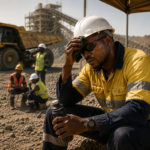
Heat Stress: Deep-level mining encounters virgin rock temperatures exceeding 50°C. Combined with auto-compression of ventilation air and heat from diesel equipment and electrical systems, underground thermal conditions can push workers into dangerous heat stress territory without adequate controls.
Arc Flash: Electrical substations, switchgear, and high-voltage distribution systems in mines present significant arc flash hazards. Switching operations and maintenance on live or isolated electrical equipment require specific arc-rated protective equipment.
Working at Height: Shaft infrastructure, processing plant maintenance, and surface operations require workers to work at height where fall protection systems are essential.
Applicable South African Compliance Considerations
Mine Health and Safety Act 29 of 1996: Section 9 requires employers to provide PPE at no cost to employees. Section 10 mandates that employees must use provided PPE. The Act gives the Minister power to make regulations regarding PPE specifications, use, and maintenance.
MHSA Regulations 3.1 and 9.2: Require mandatory codes of practice for occupational hygiene and PPE respectively. Every mine must have a documented PPE policy and programme.
DMRE Guidelines: The DMRE publishes guidance notes on PPE selection for mining, including specific guidance on respiratory protection in dusty environments, hearing conservation programmes, and head protection requirements.
SANS Standards: SANS 50397 (industrial safety helmets), SANS 50352 (hearing protection), SANS 50149 (respiratory protective devices), SANS 1381 (protective clothing), and SANS 20345 (safety footwear) all contain requirements relevant to mining PPE.
Legal Requirement vs Best Practice: MHSA requires PPE provision as a minimum. Best practice includes pre-use fit testing, comfort assessments, worker consultation in PPE selection, and integration of PPE programmes with broader occupational health surveillance.
Recommended PPE Matrix
| PPE Category | Recommended PPE |
|---|---|
| Head Protection | SANS-compliant hard hat with chin strap |
| Eye Protection | Safety spectacles or sealed goggles |
| Hearing Protection | Ear plugs or earmuffs based on noise assessment |
| Respiratory Protection | Dust masks or respirators based on risk assessment |
| Hand Protection | Task-specific gloves |
| Foot Protection | SANS-compliant safety boots |
| High Visibility | Reflective workwear |
| Fall Protection | Full body harness where required |
| Arc Protection | Arc-rated clothing where electrical risks exist |
Detailed PPE Selection Matrix
| Hazard | Recommended PPE | Relevant Standards | Inspection Frequency |
|---|---|---|---|
| Rock falls / impact | SANS 50397 hard hat, Class B impact rated, chin strap for underground | SANS 50397 / EN 397 | Daily (pre-use) |
| Silica / respirable dust | FFP2 minimum; FFP3 for high exposure; PAPR for prolonged exposure | SANS 50149 / EN 149 | Daily (pre-use); fit test annually |
| Noise >85 dB(A) | SNR-rated earplugs or earmuffs matched to noise level | SANS 50352 / EN 352 | Weekly for damage |
| Hand injuries | Cut-resistant (Level 3+), impact-resistant, chemical-resistant as task requires | EN 388 / EN 374 | Daily (pre-use) |
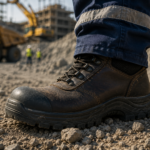
| Foot injuries | S3-rated safety boots with metatarsal guard, penetration-resistant sole | SANS 20345 / EN ISO 20345 | Daily (pre-use) |
| Vehicle interaction | Class 3 high-visibility garments (0.80m² fluorescent + 0.20m² reflective) | EN ISO 20471 | Weekly |
| Working at height | Full body harness, energy-absorbing lanyard, certified anchor points | EN 361 / EN 355 | Daily (pre-use); detailed 6-monthly |
| Arc flash | Arc-rated clothing (ATP 8-40 cal/cm² depending on hazard category), voltage-rated gloves | IEEE 1584 / ASTM F1506 | Daily |
| Heat stress | Moisture-wicking base layers, breathable fabrics, cooling vests for extreme | SANS 1381-1 | Daily |
Hazard Assessment Process
PPE selection must be grounded in formal hazard identification and risk assessment (HIRA). In mining, this is typically conducted through the following process:
Baseline Risk Assessment: Identifies all significant hazards in each workplace area. Conducted when a new mine is commissioned, a new operation begins, or at regular intervals (typically annually).
Issue-Based Risk Assessment: Conducted when new equipment is introduced, processes change, or after significant incidents. Includes specific PPE requirements for new hazards.
Continuous Risk Assessment: Conducted daily by supervisors and workers through workplace inspections and task observations. Identifies immediate PPE deficiencies.
Hazard assessment must be conducted by competent persons with knowledge of both the mining operation and occupational hygiene principles. Occupational hygiene measurements (dust, noise, heat stress, lighting) provide the quantitative data needed for PPE specification.
PPE Hierarchy of Control
PPE is the last line of defence in the hierarchy of controls. In mining, this hierarchy must be applied systematically:
Elimination: Remove the hazard entirely. Example: Replace diesel equipment with electric to eliminate diesel particulate exposure and reduce heat load.
Substitution: Replace with a less hazardous alternative. Example: Use water-jet cutting instead of flame cutting to reduce fire risk and fume generation.
Engineering Controls: Isolate people from the hazard. Example: Ventilation systems to dilute dust, refrigeration plants for heat, machine guarding for moving parts.
Administrative Controls: Change the way work is done. Example: Job rotation to limit heat exposure, work-rest cycles, exclusion zones around mobile equipment.
PPE: Protect the individual. Example: Respiratory protection where dust cannot be fully controlled by ventilation, hearing protection where noise engineering controls are insufficient.
Critical point: Providing PPE does not relieve the employer of the obligation to implement higher-order controls. MHSA inspectors will assess the full hierarchy, not just PPE provision.
PPE Selection Guidance
Head Protection: Underground operations require hard hats with chin straps to prevent dislodgment. Hard hats must be replaced after any significant impact, exposure to extreme heat, or after the manufacturer’s specified service life (typically 2-5 years). White or high-visibility hard hats improve visibility in low-light underground conditions.
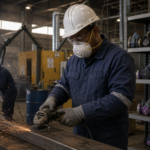
Respiratory Protection: Selection must be based on occupational hygiene measurements. For silica dust, FFP2 (SANS/EN 149) is the legal minimum; a half-mask or full-face respirator with a P3 filter is required above roughly 10 times the occupational exposure limit (OEL), and powered air-purifying respirators (PAPRs) or supplied-air systems should be considered at higher multiples still. All tight-fitting respirators require annual fit testing.
Hearing Protection: The Single Number Rating (SNR) of hearing protection must be matched to the measured noise level. Earplugs provide higher protection factors but require proper insertion technique. Earmuffs are easier to fit correctly but can be less effective with glasses or long hair breaking the seal. Dual protection (plugs + muffs) may be needed in extreme noise environments.
Hand Protection: Mining requires multiple glove types for different tasks. Impact-resistant gloves for drilling and scaling, cut-resistant for wire rope and sharp material handling, chemical-resistant for fuel handling and cleaning, and heat-resistant for welding and hot work. A one-glove-fits-all approach is dangerous.
Common Compliance Mistakes
1. Generic PPE Specifications: Specifying “safety boots” without reference to SANS/EN standards, impact ratings, or specific hazards. Result: Workers receive inadequate protection.
2. No Fit Testing: Providing tight-fitting respirators without fit testing. An unsealed respirator provides zero protection. Fit testing is mandatory under MHSA.
3. Ignoring Comfort: Uncomfortable PPE is not worn. Mines that fail to consult workers on PPE selection see significantly lower compliance rates.
4. Inadequate Training: Workers given PPE without training on correct use, limitations, and inspection. Result: Misuse, non-use, and false confidence.
5. No Replacement Programme: PPE used beyond its service life provides degraded protection. Hard hats exposed to sunlight crack; boot soles wear through; glove coatings degrade.
6. Missing Documentation: Failure to maintain PPE issue registers, inspection records, and training documentation. This creates liability exposure and prevents programme auditing.
PPE Inspection & Maintenance Guidance
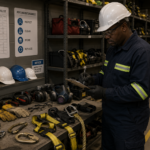
Daily Pre-Use Inspection (Worker): Hard hat — check for cracks, dents, damaged suspension. Safety boots — check for sole separation, worn tread, exposed toe cap. Respirator — check valves, straps, face seal. Gloves — check for holes, tears, worn areas. Harness — check webbing, stitching, buckles, labels.
Periodic Inspection (Competent Person): Fall protection equipment — detailed inspection every 6 months. Hearing protection — check for damage weekly in communal storage. Hi-vis garments — check reflectivity and fluorescence monthly. Safety boots — replace programme review monthly.
Replacement Criteria: Hard hats — 2-5 years or after impact. Safety boots — 6-12 months depending on conditions. Respirator filters — per change schedule or when breathing resistance increases. Gloves — daily replacement in heavy-use tasks. Harnesses — 5 years from first use or immediately after fall arrest.
Record Keeping
MHSA requires mines to maintain records of PPE issued to each employee, including type, date of issue, and expected replacement date. These records must be available for inspection by DMRE inspectors. Best practice includes:
- PPE issue register (electronic or paper-based)
- Training attendance records for PPE use
- Fit testing records for respiratory protection
- Inspection records for fall protection and other critical equipment
- Incident reports where PPE failure or non-use contributed
- Annual programme audit reports
Compliance Responsibilities
Employer Responsibilities: Provide appropriate PPE at no cost. Ensure PPE complies with relevant SANS standards. Conduct hazard assessments to determine PPE requirements. Train employees on correct use, care, and limitations. Maintain PPE in good condition. Replace worn or damaged PPE. Maintain issue and training records.
Employee Responsibilities: Use provided PPE as instructed. Report damaged or defective PPE immediately. Attend PPE training. Participate in fit testing where required. Not wilfully damage or misuse PPE.
Frequently Asked Questions
Q: Can mines require employees to purchase their own PPE?
No. MHSA Section 9 explicitly states that the employer must provide PPE at no cost to the employee. This is a non-negotiable legal requirement.
Q: How often must respirator fit testing be conducted?
Initially before first use, annually thereafter, and whenever the wearer changes respirator model or experiences significant facial changes (weight change, dental work, scarring).
Q: Are bump caps acceptable in mining?
No. Bump caps do not meet SANS 50397 / EN 397 requirements for impact protection. Only industrial safety helmets are acceptable in mining environments.
Q: Can workers wear their own safety boots?
Only if they meet or exceed the mine’s specified standards and have been verified by the employer. The employer remains responsible for ensuring PPE compliance regardless of who purchased it.
Q: What is the penalty for PPE non-compliance under MHSA?
The DMRE can issue instructions, stop work orders, and impose fines. In serious cases, individual liability may attach to managers and directors.
Key Takeaways
- Mining PPE must be specified through formal hazard assessment, not generic procurement
- MHSA requirements are more prescriptive than general OHS Act requirements
- All PPE must meet applicable SANS standards with documentation
- Respiratory protection requires annual fit testing
- Hearing protection SNR must match measured noise levels
- Hierarchy of controls must be applied before PPE selection
- Record keeping is a legal requirement, not optional
- Worker consultation in PPE selection dramatically improves compliance rates
Need Mining PPE Expertise?
Sheq Safety supplies SANS-compliant mining PPE across South Africa, including hard hats, respiratory protection, safety boots, and full PPE programmes. Our technical team can assist with hazard assessments, PPE specification, and compliance documentation. Contact us for a mining PPE consultation.
Recommended Catalogues
Related Knowledge Articles
 Site Safety
Mining Safety in Africa: Challenges, Progress, and the Role of PPE
An in-depth look at the unique safety challenges facing African mining operations and how modern PPE…
 Respiratory
 Protection in Hazardous Environments
Disposable masks to powered air systems — selecting, fitting, and maintaining respiratory protection for dust, chemicals,…
 Footwear
Choosing the Right Safety Footwear for Mining Operations
From S1 to S5 ratings, metatarsal guards to penetration resistance — a definitive guide to selecting…
 Site Safety
Maintaining and Inspecting Your PPE: A Practical Protocol
Extend the life of your safety equipment and ensure consistent protection with proper inspection, cleaning, storage,…
 Site Safety
Heat Stress Management in Industrial Environments
Practical strategies for identifying, monitoring, and mitigating heat stress risks in South African mining, construction, and…